Metaphor Lucknow LitFest & Le Press honour the pioneer who reshaped North India’s literary landscape
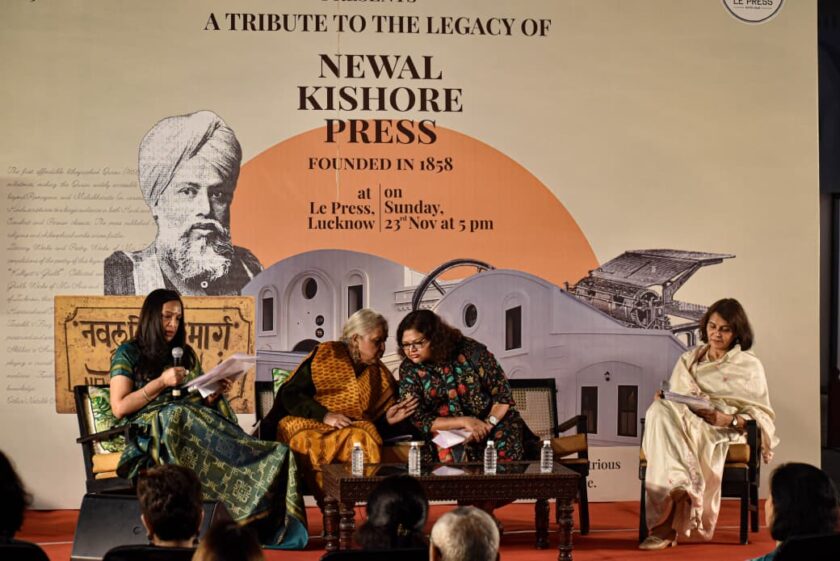
Lucknow: Lucknow witnessed a reflective and deeply meaningful evening as Metaphor Lucknow LitFest and Le Press came together to host a special commemorative gathering celebrating the towering legacy of Newal Kishore Press—one of the most influential publishing institutions in South Asian history.

Established in the 19th century, the press was instrumental in shaping the literary and intellectual discourse of North India. It pioneered Urdu, Persian, Sanskrit and Hindi publications at a scale never seen before, helping democratize knowledge and foster a reading culture that has endured across generations. The event paid tribute to its founder, Munshi Newal Kishore, whose vision continues to guide literary scholarship, archival preservation and cultural identity.
Honouring a Visionary Who Transformed Publishing
The gathering featured distinguished speakers including Nita Dube, Director of Shree Tej Kumar Press Pvt. Ltd.; Kanak Rekha Chauhan, Founder Director of Metaphor Lucknow LitFest; Dr Kirti Narain, noted historian; and Dr Amina Hasan, Assistant Professor at Avadh Girls’ Degree College.
In an emotional recounting, Nita Dube, the great-great-granddaughter of Munshi Newal Kishore, spoke about future plans to preserve the legacy in a more interactive manner.
“There are plans to do a museum. I want it to be something alive,” she said. “I want the young of the city to learn who Munshi Newal Kishore was. I would like to tell them this was the store, this was the machine room, and show them the various publications.”
Her words highlighted not only the emotional connection but also the sense of responsibility carried by the family toward preserving this monumental heritage.
A Revolution in Access to Knowledge
In her address, Kanak Rekha Chauhan shed light on the extraordinary social impact of Newal Kishore Press.
“I think his most significant contribution was the proletarization of education,” she said.
Chauhan elaborated on how, before the advent of the press, handwritten manuscripts produced by scribes or monks on precious materials like parchment and papyrus were accessible only to the aristocracy and clergy. These were rare, costly, and restricted forms of knowledge.
The Newal Kishore Press changed that reality. By printing newspapers, books, and religious scriptures at affordable prices, it made knowledge accessible to the common man—breaking the dependence on oral traditions and opening the gates to literacy for a much wider audience.

Creating a Neutral and Vibrant Intellectual Space
Historian Dr Kirti Narain emphasised the balanced intellectual ecosystem nurtured by the press.
“Cross-fertilisation between literary and journalistic writing—that’s what the Newal Kishore Press created,” she noted.
Dr Narain highlighted that Munshi Newal Kishore maintained a politically neutral stand in the vernacular journalism of the time, despite assumptions made by some.
“He was not anti or pro anyone,” she added. “He took great care to stay neutral, maintaining a delicate balance in an era of intense political undercurrents.”
Challenges of a Pre-Technology Era
Adding another dimension to the discussion, Dr Amina Hasan reminded the audience of the enormous challenges of publishing in the 19th century.
“Today we have lots of tools to help us; nothing existed then,” she said. “It was a challenge for Munshi Newal Kishore to do the job without errors.”
Quoting the legendary poet Ghalib, she added:
“Charm of Venus, Intellect of Jupiter”—that’s what Ghalib said about Munshi Newal Kishore.
A Tribute to a Cultural Giant
The commemorative gathering not only revisited the monumental contributions of Newal Kishore Press but also underscored its living influence on India’s literary, educational and cultural consciousness.
As Lucknow’s intellectual community reflected on a legacy that spans over 150 years, the event served as a reminder of the transformative power of the printed word—and of the exceptional individuals who ensured that knowledge reached every home, every learner, and every curious mind.
The evening concluded with renewed commitment to carry forward the mission of preserving this extraordinary heritage for future generations.